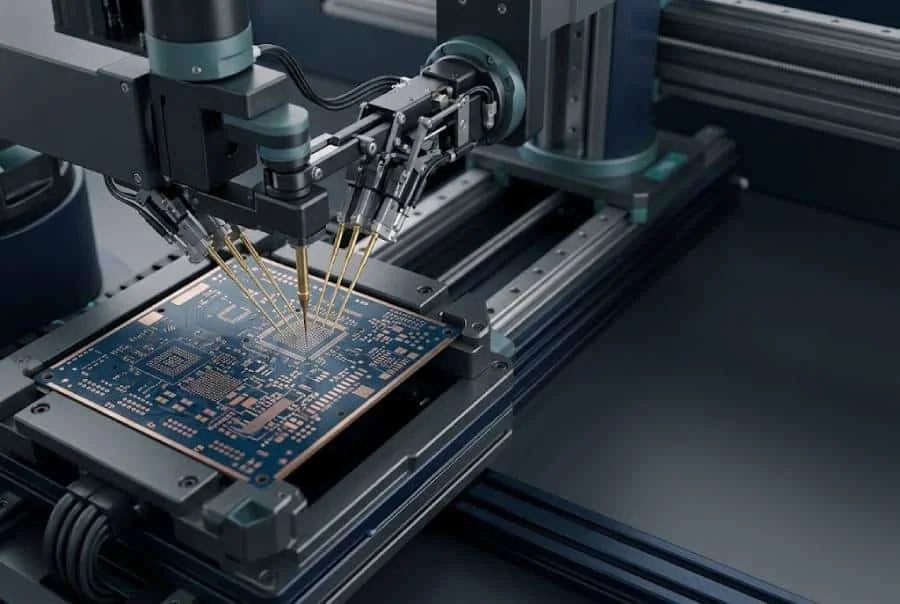
What is flying probe testing?
Flying probe testing uses programmable moving probes to contact accessible points on a bare PCB. Measurements based on the approved test data verify intended connections and isolation between separate nets. It is a fixtureless electrical test method.
Why it is relevant to prototypes
A dedicated bed-of-nails fixture is not required, making flying probe testing useful for prototypes, low-volume orders and designs with frequent revisions. The suitable test route still depends on the board, access requirements, quantity and agreed acceptance conditions.
What can it detect?
The test addresses connectivity-related manufacturing defects.
| Check | What it addresses |
|---|---|
| Continuity | Whether points intended to share a net are connected. |
| Open circuits | A missing or broken conductive path. |
| Short circuits | An unintended connection between separate nets. |
| Isolation | Whether independent nets remain electrically separated under the test conditions. |
What it does not establish
Bare-board electrical testing is not functional testing of a populated electronic assembly. It does not verify firmware or product behavior. It also does not replace dimensional inspection, internal construction analysis or a separately specified impedance measurement.
Define the test basis
Keep the test data aligned to the approved fabrication revision. Identify any required netlist, test records and acceptance criteria during quotation. If the customer needs a particular reporting format, resolve it before manufacturing release.
Flying probe versus fixture-based testing
Flying probe avoids dedicated fixture preparation; fixture-based methods use purpose-built contact tooling. Quantity, revision stability and test access affect the selection. Ask which method is proposed for the actual build instead of assuming that one method is appropriate for every order.
Questions, answered
Before your next build
Does flying probe testing require a dedicated fixture?
No. Programmable moving probes contact the required accessible points. This fixtureless approach is useful for prototypes and changing designs.